

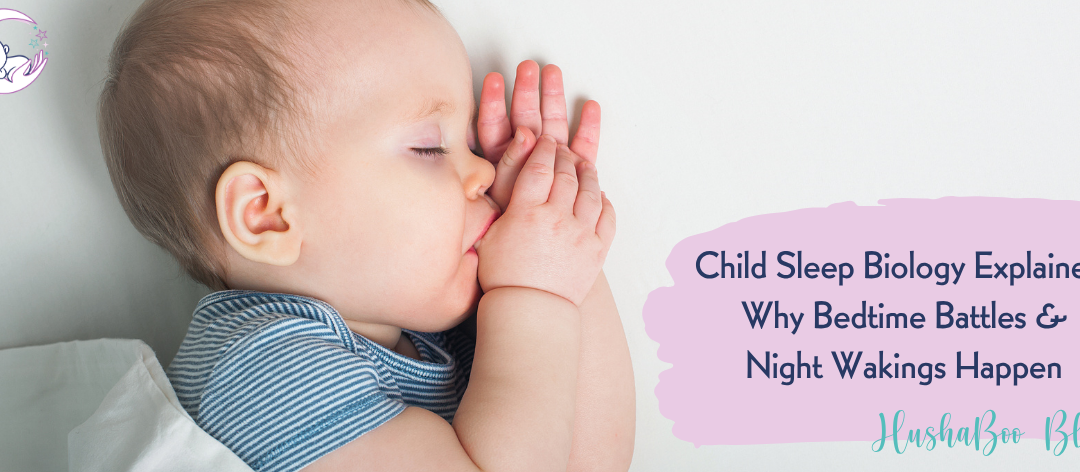
Child Sleep Biology Explained: Why Bedtime Battles & Night Wakings Happen
Understand how circadian rhythms and sleep pressure shape your child’s unique sleep patterns
Generic routines don’t work for every baby – they each have their own unique sleep biology which is made up of the timing of their natural circadian rhythm, their sensitivity to sleep pressure, and their individual sleep needs.
So what are the contributing factors to our unique sleep biology?
Chronotype
Our chronotype is our individual sleep-wake preference, and it shifts quite dramatically across a lifespan. Babies and young children are mostly predisposed to wake early and go to sleep early, shifting to a much later rhythm of late evenings and late rising during adolescence, before gradually shifting back towards an early chronotype as we progress throughout adulthood.
However within this general pattern, there’s room for unique preferences, to be a ‘morning lark’ or a ‘night owl’. But are these variations predetermined, or can we modify our child’s natural inclination?
Approximately 50% of our chronotype is determined by genetics, with the other half open to environmental factors (including age). This hard wired genetic coding makes it very difficult to change the underlying predisposition, however a slight shift of your child’s schedule can be achieved by adapting their circadian rhythm.
Key takeaway: Track your child’s natural rhythms in a diary to pinpoint their natural propensity for alertness or sleep.
Circadian rhythm
While your chronotype is your behavioural expression of your ideal circadian rhythm, it can be trained to some degree. Like an adult ‘night owl’ struggling to adapt to the culture of 9-5, a child who is misaligned with textbook sleep schedules may appear to have a sleep issue, when in fact they are just behaving in line with their biology.
Your child’s 24 hour body clock tells them when to rise for the day, and when it’s nearly bedtime, and when out of sync it can be linked to early rising, bedtime battles, and difficult naps.
You can support your child’s circadian rhythm by:
- controlling light exposure – set their clock by including bright, natural light as early as possible in the morning, dimming lights after bath, and avoiding artificial ‘blue’ light an hour before bed
- consistent scheduling – stabilise their rhythm by sticking to consistent wake up and sleep times (ideally within half an hour each day), as well as mealtimes
Hormonal balance
The sleep/wake cycle is regulated by the hormones, interacting in a finely tuned balancing act across the day and night. Melatonin, the ‘hormone of darkness’, is produced by the pineal gland to induce sleepiness towards bedtime. Cortisol acts as the opposing ‘wake-up’ hormone that instructs the body to rise and increases alertness.
A key factor in correctly timed melatonin production is serotonin. Often referred to as the feel good hormone, it also plays a huge role in regulating your child’s body clock. Healthy serotonin levels are maintained by exposure to natural daylight, with movement and time spent outdoors, and consistent rhythms contributing to overall wellbeing. As melatonin is made from serotonin, low levels directly impact the ability to fall asleep happily, so what happens in the day can directly influence the evening wind-down.
Elevated stress levels can impact serotonin production, so your little one may struggle when experiencing:
- emotional stress from developmental leaps, changes in routine (like starting nursery) and milestones (such as toilet training)
- inconsistent routines
- overstimulation from loud noise and a busy day
- over tiredness – one of the most common daily forms of stress
While stress cannot be avoided, a consistent routine to provide a baseline where your child feels safe enough to regulate and reset is crucial for all children, regardless of their individual sleep preferences.
Sleep pressure
Sleep isn’t just about hormones, or the circadian rhythm – it can change within each day thanks to sleep pressure. Adenosine, a chemical that builds sleep pressure throughout the day, accumulates the longer your child is awake, creating a natural drive for sleep. When your child naps, some of the sleep pressure is released, which is why timing and balance matter.
As your child stays awake, sleep pressure builds. At the same time, their body is preparing for rest by increasing melatonin. If this is aligned, all will go smoothly at bedtime.
But if that window is missed, and your child stays awake for too long, the body does’t keep getting sleepier, it switches strategy.
Instead of continuing to wind down, the body releases cortisol, putting them into a wired state and making it difficult for them to settle and drift off. Even once asleep, elevated cortisol inhibits deep, restorative sleep, causing ‘false starts’ after bedtime, frequent night waking and reduced sleep quality. The surge of cortisol directly counteracts the effects of melatonin, causing one very over-tired baby.
Ultimately, when sleep pressure builds and is met by the simultaneous production of melatonin, sleep and happy settling is fully supported. When sleep pressure builds for too long, cortisol steps in, disrupting sleep, instead of supporting.
You can manage over tiredness by:
- spotting early sleep cues – yawning, eye rubbing and disengagement
- soothing techniques – a dark, quiet room, with physical calming measures such as cuddles, swaddling and rocking to reduce cortisol levels
- preventative naps – a last top up of sleep to reset the cortisol spike on poor nap days
- early bedtime – put them to bed earlier, not later, to break the cycle
Key takeaway: Over tiredness doesn’t mean more sleep pressure equals better sleep – it often means the opposite, because the body has shifted from sleep mode into survival mode. Your baby is tired, but in the wrong way.
Sleep sensitivity
While sleep pressure builds in all children, not all children experience it in the same way. Each baby has their own sensitivity to sleep pressure, meaning the same amount of awake time in a similar aged baby or child, can feel very different from one to the other.
While your friend’s baby may happily stay awake longer, yours may become overwhelmed more quickly, needing sleep sooner, or vice versa!
Wake windows can be a helpful guide, but they are certainly not a one-size-fits-all rule. Your baby’s cues and temperament tell you where their true window sits – and I see wide variation in my consultancy work.
A baby who is more sensitive to sleep pressure may reach that overtired, cortisol driven state much more quickly, even if they haven’t been awake for long. Here’s how to spot your child’s sensitivity.
More sensitive babies may:
- Become fussy, irritable or dysregulated quicker
- Have more frequent episodes of sleep resistance
- Suddenly switch to high pitched crying before sleep that is hard to comfort
Less sensitive babies may:
- Tolerate longer wake windows
- Seem quite content right up until sleep
- Have a wider window before cortisol kicks in
Think of sleep pressure like a rising cup of water – for some children it fills slowly, for others it fills quickly. The goal isn’t to follow the clock exactly, but to catch it before it overflows.
Individual sleep needs
I have a guide on my website and that I send to every parent I work with – the ‘how much sleep’ guide. It comes with a warning though, it is simply an ‘average’ and certainly not a rule, as the biological range is huge.
The variation between how much sleep they need in a 24 hour period and how this is split between day and night differs greatly from child to child. Some sleep more consolidated stretches at night, with minimal naps, or vice versa, and everything in between!
Sleep architecture is largely developmental, not behavioural, and typically shifts and changes over time as they grow. When sleep pressure, circadian rhythm and hormonal balance are aligned, a baby will naturally distribute their sleep in a way that suits their individual biology.
The only caveat to this is if a child struggles with self-settling – while not crucial for all, it certainly assists the babies I work with to ‘sleep train’ them by creating a confident sleeper who isn’t anxiously seeking parental assistance every time they stir in between sleep cycles.
In summary
Sleep isn’t driven by one single factor – it’s the result of several biological systems working together in real time.
Your child’s circadian rhythm sets the overall timing of sleep and awake, influenced by light and daily patterns. Throughout the day, serotonin helps build the foundation for calm regulation and later becomes the building block for melatonin, the hormone that supports sleep onset. At the same time, adenosine steadily increases sleep pressure the longer your child is awake, creating the natural drive for rest.
But when this balance is pushed too far, the body doesn’t simply become ‘more tired’ – it can shift into a different state. Cortisol, the stress hormone, may rise, especially in overtired or overstimulated moments, making it harder for the body to settle even when sleep pressure is high.
And running through all of this is something just as important: individuality. Every child has their own sensitivity to sleep pressure, their own threshold for wakefulness, and their own way of responding to the same biological signals.
When you understand your child’s sleep as the interaction of rhythm, hormones, pressure, and personality – it stops being something to fix, and becomes something you learn to read.
If you’re struggling to make sense of your child’s sleep, get in touch to book my free 15 minute assessment call to help you understand what’s really going on beneath the surface, and disocver how to move forward.
You can also sign up to the HushaBoo email updates to be the first to find out about future blogs. Or follow HushaBoo on social media.
Blogged by Emma Osborne, Paediatric Sleep Specialist, founder of HushaBoo & Mum to one little boy

Child Sleep Biology Explained: Why Bedtime Battles and Night Wakings Happen
Recent Comments