


Little ones with BIG emotions
How to cope with your child’s emotions when they become challenging and overwhelming
Did you know it takes men until an average age of 43 years to mature, with women on average maturing around 11 years earlier at the age of 32? Even with the first time parenting age going up and up in recent years, we are still only just equipped with emotional maturity by the time we are having children of our own. Supporting our children through every stage of development is hard enough, but with research and general parenting style taking a huge shift since our parents brought us up, it’s no wonder many parents I support struggle with meeting the psycho-social needs of their children. It’s the start of a very long journey, with many bumps along the way when the emotions become overwhelming and seemingly unmanageable. So how on earth can we support our little people through such big emotions?
Social and Emotional Learning (SEL)
Social and emotional learning (SEL) is now a key part of nursery and school curriculums, and thankfully there is much more support and focus on helping our children become emotionally healthy adults. There are 5 key areas to SEL:
Self-awareness: The ability to accurately recognise one’s emotions and thoughts and their influence on behaviour. This includes accurately assessing one’s strengths and limitations and having a well-grounded sense of confidence and optimism.
Self-management: The ability to regulate one’s emotions, thoughts, and behaviours effectively in different situations. This includes managing stress, controlling impulses, being self-motivating, setting personal and academic goals and working to achieve them.
Social awareness: The ability to empathise with and understand the perspective of others from diverse backgrounds and cultures. This includes understanding social and ethical norms of behaviour, and recognising family, school, and community resources and supports.
Relationship skills: The ability to establish and maintain healthy and rewarding relationships with diverse individuals and groups. This includes communicating clearly, listening actively, cooperating, resisting inappropriate social pressure, negotiating conflict constructively, and seeking and offering help when needed.
Responsible decision-making: The ability to make constructive and respectful choices about personal behaviour and social interactions. These choices are based on a consideration of ethical standards, safety concerns, social norms, the realistic evaluation of consequences of various actions, and the well-being of self and others.
This blog focuses mainly on the first 2 key areas, the ability to both recognise and regulate their emotions, but naturally the skills obtained are vital for the success of the latter 3 areas.
What age do BIG emotions form?
There are very distinct stages in the path of child development and it has never ceased to amaze me how one day Davey can go to bed and wake up the next day a different child! Although there are many small increments in emotional development, the shift from baby to toddler is huge when it comes to how emotions are processed and expressed.
Developmental psychologist Erik Erikson set out 8 distinct stages in social development, 3 of which occur in the first 5 years of life. There is rapid growth in the social and emotional areas of the brain in the first 18 months, where the primary emotional need is one of trust. Social-emotional development begins with parent-child bonding, forming the basis of attachment which is essential for good quality sleep skills, as well as wider emotional development. Incredibly, babies learn emotional communication through smiling, waving and other means, well before speech and language acquisition.
Stage 2 concerns ages 1 to 2 years, where toddlers often start to feel much more complex emotions but struggle to express them in ways deemed ‘acceptable’. They are looking for us to model empathetic behaviour, as well as providing them with words to match their emotions. The labelling of these emotions is key to successfully moving to the next stage, with Erikson stating that children with supportive parents by the end of this stage will usually have confidence, will, self-control, and pride.
The final early years stage occurs between the ages of 3 and 5 years of age. Pre-schoolers are starting to interact more closely with their peers, and the goals in this stage include using imagination, cooperating with others, and serving effectively as both leaders and followers. If in the previous stage they have successfully formed the basis of what emotions are, they can now learn through interaction with both children and adults how to express them in ways that are socially acceptable. They are still heavily reliant on us to provide the modelling, feedback and encouragement to gain the necessary language and social skills for well-rounded emotional development.
How is sleep affected?
Bedtime battles are a very common issue I see that stem from an emotional imbalance. Too much choice, not enough choice. Too much stimulation, not enough emotional connection. Throw in the emergence of fears and anxieties which further drain our child’s emotions and it’s no wonder that bedtime is the primary source of sleep issues I see in the toddler and pre-school years.
There’s lots more information to be found on bedtime support and how to calm them here, but ensuring your child is emotionally balanced come bedtime is a great start.
Their Emotional Cup
One of the main things children, and indeed all humans, crave, is emotional connection. They want to feel loved, heard and understood. But as they have very little control over both the day-to-day running of their lives and emotions, life can be very difficult for our little people. It is crucial for children to have their emotional cup as full as possible before bedtime in order to settle down at bedtime, and sleep soundly overnight.
What drains a child’s emotional cup?
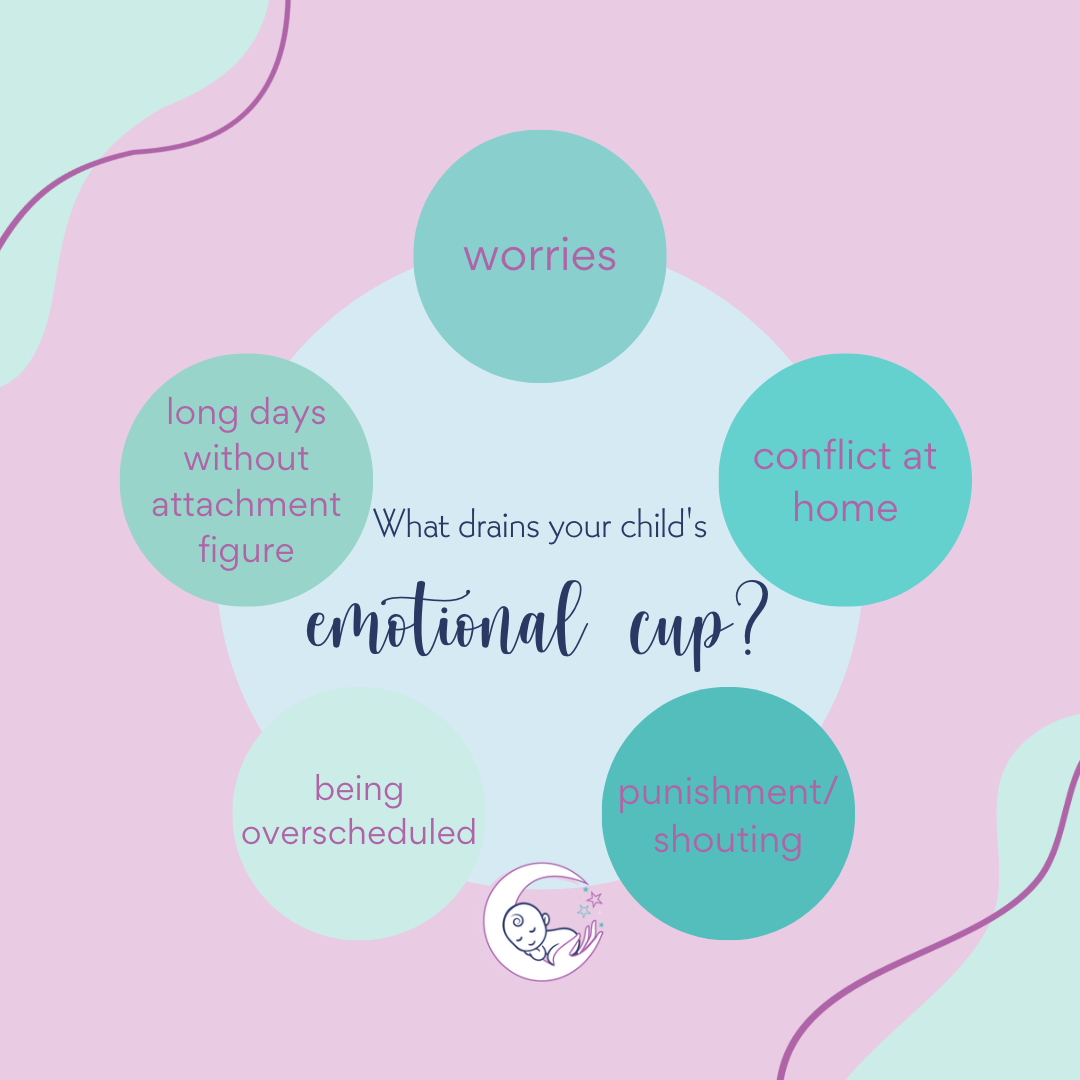
If you’re child is feeling low, how can you fill it up?

Here’s my top 7 tips on how to help your child through big emotions:
Validate feelings; the most important thing a child needs to know when they feel an emotion is to know that they’re not the only one feeling it. Label it, and help them understand that what they are feeling is completely normal. Try phrases such as “I know you’re feeling frustrated right now, I also feel frustrated when _____ ”.
Talk positively; there’s no benefit to chastising a child for a feeling. Instead, validate as above, offer them helpful solutions and make feelings fun. My favourite book on emotions is Anna Llenas’ ‘The Colour Monster’.
Give praise; when they manage to respond to an emotion with an appropriate reaction, offer them lots of praise and encouragement for making the right choice.
Teach them strategies; feelings are always present throughout life and so we all need simple strategies to help us cope when things just become overwhelming. Coping strategies may be adapted for each child and individual emotions, but can include breathing techniques, alone time, and distraction with music, colouring and conversation.
Get on their level; this applies both figuratively and literally. Children need to know you’re truly listening, and only then will they engage fully. Remember, the basis of all emotional development is trust, and getting down on your child’s level goes a long way to gaining this when they are in the middle of an emotional rollercoaster.
Check their needs; children’s emotions are often heightened when their basic needs aren’t being met. If your child is becoming irrational, check for hunger, thirst, tiredness, overstimulation and toileting.
Have realistic expectations; expecting too much from your child emotionally will often lead to frustration and disappointment, which means children may go on to associate their feelings with shame, embarrassment and anxiety. Allow them the time to grow and develop at a normal pace, feeling support rather than judged.

Emotions are very much tied to sleep behaviours from toddlerhood onwards, and managing them is always part of any sleep plan I put together for parents. If you’re struggling with BIG emotions in your little one, I offer a free 15 minute assessment call so get in touch if you want to chat more about any issues you’re having, and find out if and how I can help.
You can also sign up to the HushaBoo email updates to be the first to find out about future blogs. Or follow HushaBoo on social media…
Blogged by Emma Osborne, Paediatric Sleep Specialist, founder of HushaBoo & Mum to one little boy, and who has taught me how to navigate my own emotions!

Little ones with BIG emotions

Recent Comments